EN


How to Evaluate Electric Coffee Roaster Capacity for Commercial Production
For a commercial buyer, the useful capacity of an electric coffee roaster is not simply the largest number printed on a quotation. It is the amount of consistent, saleable roasted coffee that the full operation can produce per hour, per shift, and per week. That distinction matters when green-bean receiving, roasting, cooling, resting, packaging, and labor all have to work as one system.
This guide gives procurement teams a practical way to compare electric coffee roaster options without treating unverified supplier figures as certain production results. Use it to turn a stated batch size or continuous-feed rating into a capacity plan that can be tested with your own beans, roast profiles, and staffing model.
Start With the Output You Need to Sell
Begin at the dispatch end of the process. Estimate the kilograms of roasted coffee required per day for wholesale orders, retail packs, subscriptions, or internal use. Then convert that target into green-bean demand. Roasting reduces mass, and the loss changes with bean condition and roast development. A useful planning formula is:
Roasted output = green-bean input × (1 − roast weight-loss rate)
Training references commonly describe a broad 11–24% weight-loss range, depending on starting moisture and roast level. That range is not a machine guarantee. Instead, use your own historical roast loss where available, or run representative trials before approving an electric coffee roaster. A buyer selling 800 kg of roasted coffee per week, for example, should calculate green-bean demand using the target profile rather than assuming every kilogram loaded becomes one kilogram packed.
Also separate average demand from peak demand. A roaster that covers normal volume but cannot absorb seasonal orders, maintenance time, or profile changes may create a packaging and delivery bottleneck. Define an acceptable utilization level and leave capacity headroom for the production realities that a nameplate figure does not show.
Translate Rated Batch Size Into Cycle-Based Throughput
For a batch electric coffee roaster, hourly throughput depends on the whole cycle: loading, roasting, discharge, cooling, inspection, and the time needed to prepare the next batch. The basic planning model is:
Hourly green-bean throughput = usable green-bean charge per batch × completed cycles per hour
Do not replace “usable charge” with the maximum theoretical drum volume. The practical charge may vary by bean density, desired roast level, airflow, and the producer’s profile requirements. Ask the supplier to state the tested batch load, bean type, roast endpoint, roast time, cooling time, and whether loading and cooling overlap with the next cycle.
A continuous machine should be assessed differently. Confirm the stated feed rate, the residence time through heating and cooling zones, the product flow at start-up and shut-down, and how the equipment handles changes in bean origin or roast profile. A continuous line can provide steady output, but its commercial value depends on how well upstream feeding and downstream handling keep pace.
Map the Bottlenecks Around the Roaster
Commercial capacity belongs to the line, not just to the heating chamber. Before selecting coffee roaster equipment, map each step from green storage to packed product. The slowest required step sets the usable production rate.
- Green-bean staging: Can operators weigh, clean, and stage the next lot before the current roast ends?
- Cooling and de-stoning: Is cooling fast enough to protect the planned cycle rhythm, and is post-roast handling sized for the same flow?
- Resting and storage: Is there enough bin or container capacity for roasted coffee before packing?
- Packaging: Can weighing, filling, sealing, coding, and carton handling absorb the roaster’s output during busy periods?
- Ventilation and utilities: Are electrical supply, exhaust, chaff management, and room layout designed for the intended operating schedule?
- Labor and quality checks: Who monitors profiles, performs sampling, records lots, and handles changeovers?
This line-level view prevents a common purchasing error: buying a faster electric coffee roaster while cooling, packing, or operator availability remains unchanged. The result can be underused equipment rather than more saleable output.
Compare Batch and Continuous Production Against Your Mix
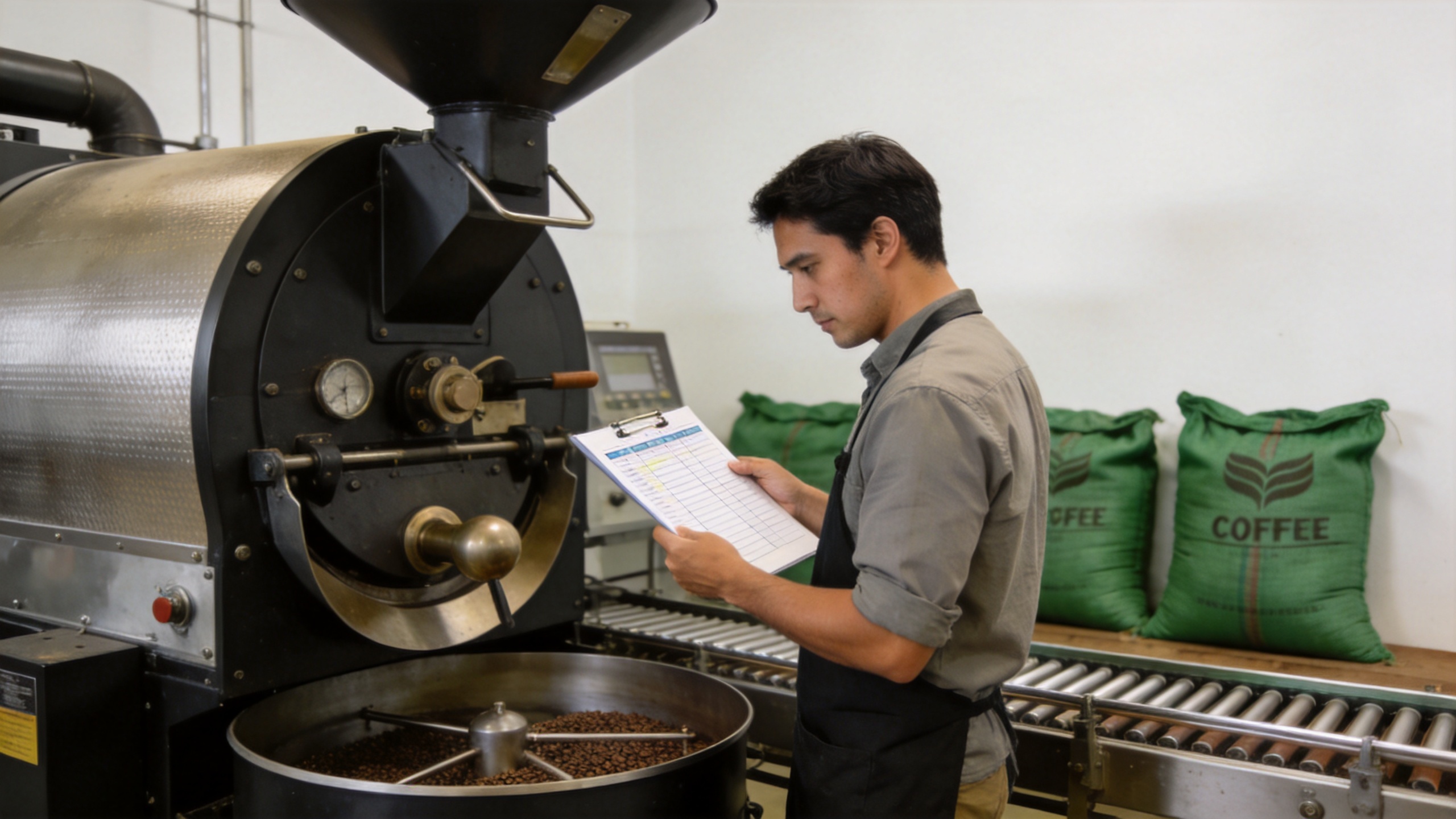
The right process format depends on SKU count, lot size, profile variation, and the way orders arrive. Batch roasting can suit businesses that need frequent changes between origins, blends, or roast levels. It gives teams a clear batch record and can be easier to align with varied product schedules. Its throughput, however, must include all non-roasting minutes.
Continuous roasting can make sense when demand is stable and the product mix is relatively repeatable. The buyer should evaluate continuity across the complete system, including feeding, cooling, collection, and packing. Ask what happens during product transitions, planned cleaning, and unexpected interruptions; these factors affect the usable average rate over a shift.
For either format, request a production scenario rather than a single capacity statement. A good scenario lists green input, finished output, cycle or feed assumptions, operating hours, expected downtime, and the product conditions used for the test.
Use a Supplier Specification Checklist
Capacity discussions become more reliable when every supplier responds to the same questions. Include the following in your request for quotation:
- What is the recommended and maximum green-bean charge or feed rate for the proposed electric coffee roaster?
- Which bean type, moisture condition, and roast target were used to establish the stated output?
- What are the typical roasting, cooling, discharge, and changeover times?
- Is the quoted rate green-bean input or roasted-coffee output?
- What utility requirements apply at the intended production rate, including power, exhaust, and dust or chaff handling?
- Which components limit the line rate: feeder, roaster, cooler, conveyor, de-stoner, or packer?
- What production data can be captured for profile repeatability, batch traceability, and troubleshooting?
- What installation, operator training, spare-parts, and remote support are included?
When reviewing a supplier’s configuration, ask for the exact machine scope rather than inferring capabilities from a product title. For example, the supplier’s commercial belt continuous electric roasting machine can be a starting point for a scope discussion, but buyers should verify the material, test conditions, commercial capacity, utilities, and downstream integration required for their own coffee program.
Capacity Worksheet for an Electric Coffee Roaster
Use this worksheet during each electric coffee roaster comparison. It keeps the capacity conversation tied to production evidence rather than a headline rating.
| Capacity item | What to record |
|---|---|
| Electric coffee roaster charge | Record the recommended green-bean load, not only the maximum stated volume. |
| Electric coffee roaster roast time | Measure the actual minutes for the intended bean and roast target. |
| Electric coffee roaster cooling time | Confirm whether cooling delays the next load or runs independently. |
| Electric coffee roaster cycles | Count complete cycles per hour, including loading and discharge. |
| Electric coffee roaster yield | Weigh green input and finished output for each representative profile. |
| Electric coffee roaster downtime | Include cleaning, profile changes, inspections, and planned pauses. |
| Electric coffee roaster utilities | Verify electrical supply, exhaust, and chaff collection at the intended rate. |
| Electric coffee roaster staffing | Identify who loads, monitors, cools, records lots, and releases product. |
For each electric coffee roaster, calculate a normal-shift result and a peak-shift result. The normal case should use ordinary staffing and product mix. The peak case should include the longest planned roast, a realistic changeover, and the downstream packaging rate. Review the electric coffee roaster worksheet with the supplier and ask them to mark which values are tested, estimated, or buyer-dependent.
Apply the same discipline to coffee roaster equipment surrounding the heat source. A faster electric coffee roaster cannot improve shipped output if bins, cooling, de-stoning, or packaging are slower. When comparing quotes, keep the electric coffee roaster calculation beside the complete line layout and acceptance-test plan.
Validate Capacity With a Short Acceptance Test
Before final acceptance, agree on a test that resembles production. Use representative green beans, at least one target roast profile, defined loading or feed conditions, and a stated observation period. Record input weight, finished weight, cycle times, rejected product, temperature or profile records where available, operator interventions, and cleaning or transition time.
Compare the result with the original production model. If actual saleable output is lower, identify whether the cause is roast loss, a conservative usable batch load, slow cooling, material handling, or a utility constraint. This gives both buyer and supplier a factual basis for resizing equipment or adjusting the line layout before commercial commitments are made.
Make the Capacity Decision on Verified Output
A well-chosen electric coffee roaster matches more than a target batch size. It matches expected roasted output, product variety, staffing, utilities, quality controls, and the rate of every connected process. Build the estimate from green input to packed product, apply your real roast-loss assumptions, and insist that supplier specifications identify the conditions behind each number.
That approach gives commercial teams a clearer comparison between batch and continuous options, reduces the chance of hidden bottlenecks, and creates a realistic production plan before equipment is installed.