EN


How to Plan an Automated Cashew Processing Line for Higher Throughput
An automated kaju processing plant is not a collection of machines placed in a row. It is a coordinated production system in which receiving, conditioning, shelling, peeling, grading, and packing must move at compatible rates. For a factory owner or procurement team, the planning decision is therefore about stable flow, kernel quality, labour exposure, sanitation, maintenance access, and the ability to expand without rebuilding the whole line.
Many projects start by asking for the capacity of a sheller. A better first question is: what saleable kernel output must the kaju processing plant deliver per shift, and where could material accumulate or wait? Starting with that answer makes equipment selection more practical and makes supplier quotations easier to compare.
Start with a production basis, not a machine list
Before specifying equipment, define the raw-cashew intake, planned operating hours, expected product mix, target grades, packing formats, and the acceptable level of manual handling. The production basis for a kaju processing plant should also state whether the priority is maximum throughput, a higher whole-kernel yield, flexible product changeovers, or a balanced combination of these goals.
Translate the finished-kernel target backward through the process. Each operation has losses, hold time, and a practical output range. If one upstream section supplies more material than the next section can process, the kaju processing plant creates work-in-progress rather than throughput. This is why a line calculation needs buffers and transfer points as well as machine capacities.
- Set a shift-level target and identify the intended daily operating pattern.
- Separate raw material flow, edible-kernel flow, shells, rejects, and packaging materials.
- Define the grade mix and packing requirements before selecting final sorting and packing equipment.
- Allow a realistic commissioning margin instead of designing every station at its published maximum.
Map the process and balance the critical stations
A typical kaju processing plant links receiving and cleaning with conditioning, shelling, kernel separation, drying or moisture conditioning, peeling, grading, inspection, and packing. The exact sequence should fit the raw material condition and the factory’s process method. Process references commonly describe connected operations such as storage, calibration, shelling, drying, and peeling; the practical planning task is to make the handoff between them predictable.
Identify the constraint before committing to automation. In one kaju processing plant, shelling may limit flow; in another, peeling, visual sorting, or packing may constrain the shift. Capacity should be compared in the same unit and time basis at every station. A supplier should be able to explain the assumed feed condition, labour input, and material handling method behind each stated output.
| Planning area | Question to resolve | Why it matters |
|---|---|---|
| Buffering | Where can product wait without quality or traceability problems? | Protects downstream stations from short interruptions. |
| Transfers | How will material move between hot, dry, and packing areas? | Reduces manual carrying and uncontrolled handling. |
| Inspection | Which defects or grade decisions need human verification? | Balances automation with market-specific quality control. |
| Changeover | What must be cleaned or adjusted between grades and formats? | Prevents planned flexibility from becoming lost production time. |
Choose automation where it improves the whole line
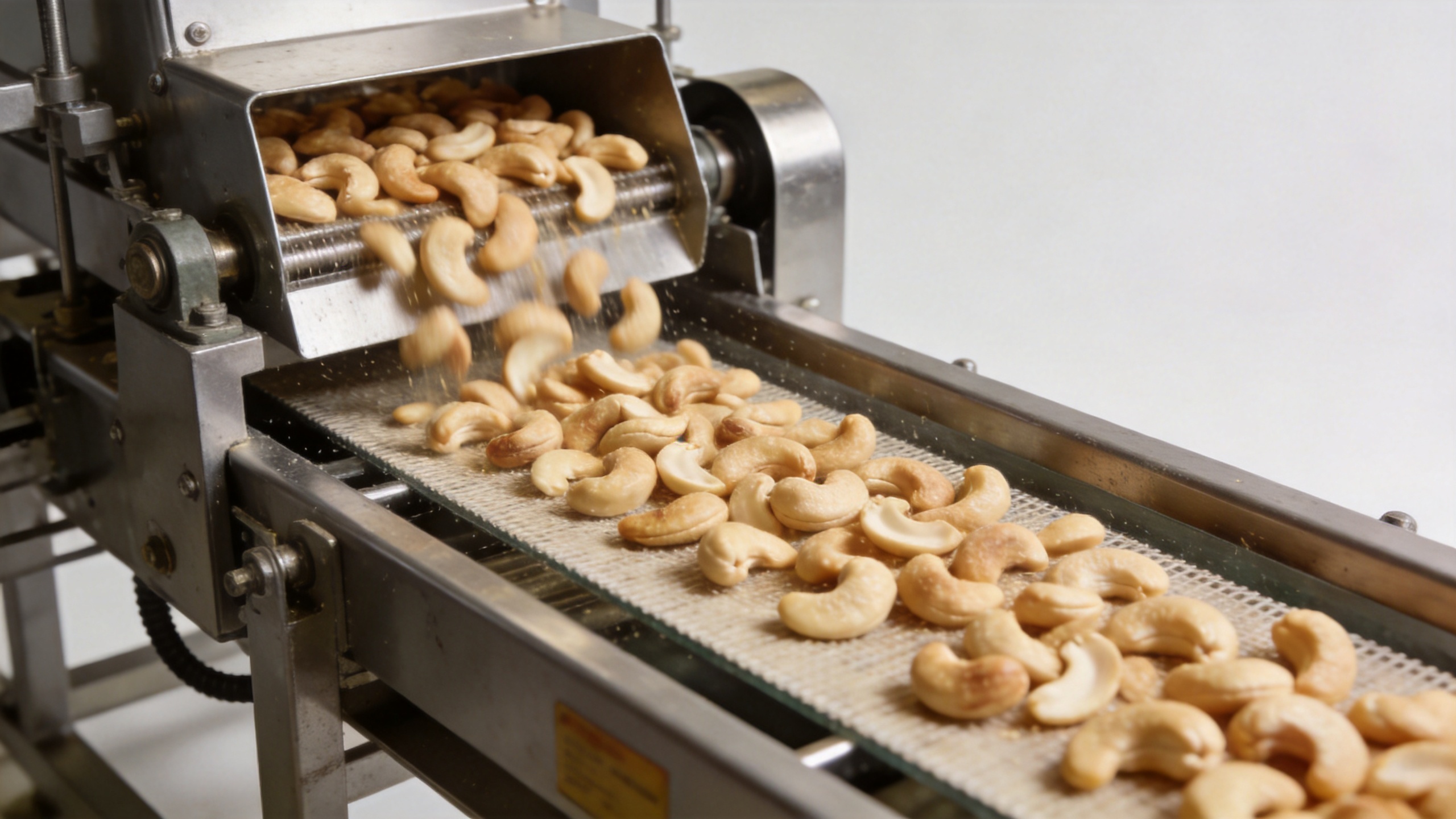
Automation in a kaju processing plant should solve a measured operating problem. Automatic feeding and conveying can stabilize machine loading. Controlled handling can reduce repetitive transfer work. Grading and packing automation can improve consistency when the incoming kernel stream is already stable. However, automating an unstable step only moves the instability downstream.
For that reason, evaluate the kaju processing plant by interfaces: feed consistency into the sheller, safe collection after shelling, the condition required before peeling, and how graded kernels reach packaging. Ask for the control logic, alarm conditions, cleaning access, spare-part list, and operator tasks. Those answers reveal more about day-to-day performance than a headline automation claim.
Where a complete system is required, review the confirmed product option for an industrial cashew nut shelling, peeling, and packing processing machine line alongside the site layout and the production basis. The product page is a starting point for a technical discussion, not a substitute for line-specific validation.
Design the layout around hygiene, service, and traceability
A productive kaju processing plant also needs a workable physical layout. Keep raw-material receiving, heat-related operations, kernel handling, and finished-product packing logically separated. Plan access routes for cleaning, routine inspection, material replenishment, and maintenance. If operators cannot safely reach a sensor, belt, or inspection point, the line will be harder to keep stable.
Food-safety guidance for cashew processing emphasizes good manufacturing practices, hygiene, and traceability. Build these requirements into the kaju processing plant layout from the start: define lot identification at receiving, decide where records follow the product, and avoid cross-traffic between waste streams and packed kernels. This approach is more reliable than trying to add controls after installation.
Evaluate suppliers with a line-level acceptance plan
For a decision-stage purchase, compare proposals on the same operating assumptions. A credible supplier of a kaju processing plant should help clarify the process scope, utilities, layout inputs, automation boundaries, training needs, and commissioning sequence. For export projects, also review documentation, packaging for transport, remote technical support, and spare-part planning.
- Request a flow diagram that names each station and transfer point.
- Ask which station is expected to be the bottleneck and how it will be managed.
- Confirm utility requirements, floor-space assumptions, and maintenance clearances.
- Define factory-acceptance criteria using feed condition, operating time, output measurement, and quality checks.
- Agree on commissioning support, operator training, manuals, and recommended spares before shipment.
Build expansion into the first layout
A scalable kaju processing plant does not have to purchase every future module on day one. It should, however, reserve sensible space, connection points, and buffer locations for a later increase in capacity. Modular thinking is especially useful when raw-cashew supply or product demand changes over time.
The right automated kaju processing plant is the one whose stations are balanced around the factory’s real raw material, quality target, labour plan, and service capability. By fixing the production basis first, validating interfaces, and using an acceptance plan before purchase, buyers can turn automation into a controlled route to higher throughput rather than a costly collection of isolated equipment.