EN


Vegetable Cleaner Machine Maintenance Checklist for Food Processing Operations
A vegetable cleaner machine works at the front of a food-processing line, where water quality, product debris, moving parts, and hygiene controls meet. A missed inspection can create more than an inconvenient stoppage: it can leave soil in a food-contact zone, reduce wash consistency, or delay the next production run. This practical checklist is written for operators and production supervisors who need a repeatable routine before, during, and after each shift.
The goal is not to dismantle the machine every day. It is to verify that the vegetable cleaner machine is clean, safe, correctly assembled, and ready to move produce through the washing stage. Follow the equipment manual, your site sanitation procedures, and any stricter local food-safety requirements.
Start With a Safe Shutdown and a Clean Work Area
Maintenance begins with control of the work area. Before opening guards, removing a screen, or reaching into a wash tank, stop the vegetable cleaner machine, isolate its energy sources, and confirm that moving parts have stopped. Use the lockout and tagout process required by your facility. Water, detergent residue, and vegetable waste can make floors slippery, so clear the drain area and use appropriate personal protective equipment.
Remove loose leaves, stems, soil, labels, and other visible debris from the exterior, infeed, discharge, and surrounding floor. Do not push debris toward drains if it can block them. A clean perimeter makes leaks, loose fasteners, and abnormal vibration easier to spot at the next start-up.
Daily Cleaning Checklist for Food-Contact Surfaces
For every production day, clean the product path in the order specified by your sanitation program. In most operations, the useful sequence is remove gross soil, rinse as appropriate, apply the approved cleaner, rinse again if required, then apply sanitizer at the correct concentration and contact time. Cleaning comes before sanitizing; sanitizer is not a substitute for removing soil from food-contact surfaces.
- Empty the tank and remove loose produce debris from baskets, screens, conveyors, and drain covers.
- Inspect spray nozzles, air-bubble manifolds, water outlets, and recirculation openings for clogging.
- Clean accessible food-contact surfaces, including corners, seams, guides, and underside areas that are easy to overlook.
- Rinse and sanitize using only chemicals approved by the site procedure and compatible with the machine materials.
- Let surfaces drain or dry as required before reassembly; do not leave cleaning tools or chemical containers on the machine.
Record the completed sanitation task. A short record with date, shift, operator, and corrective action is more useful than a checkbox alone when the same issue returns.
Inspect the Water Circuit Before It Causes a Wash-Quality Problem
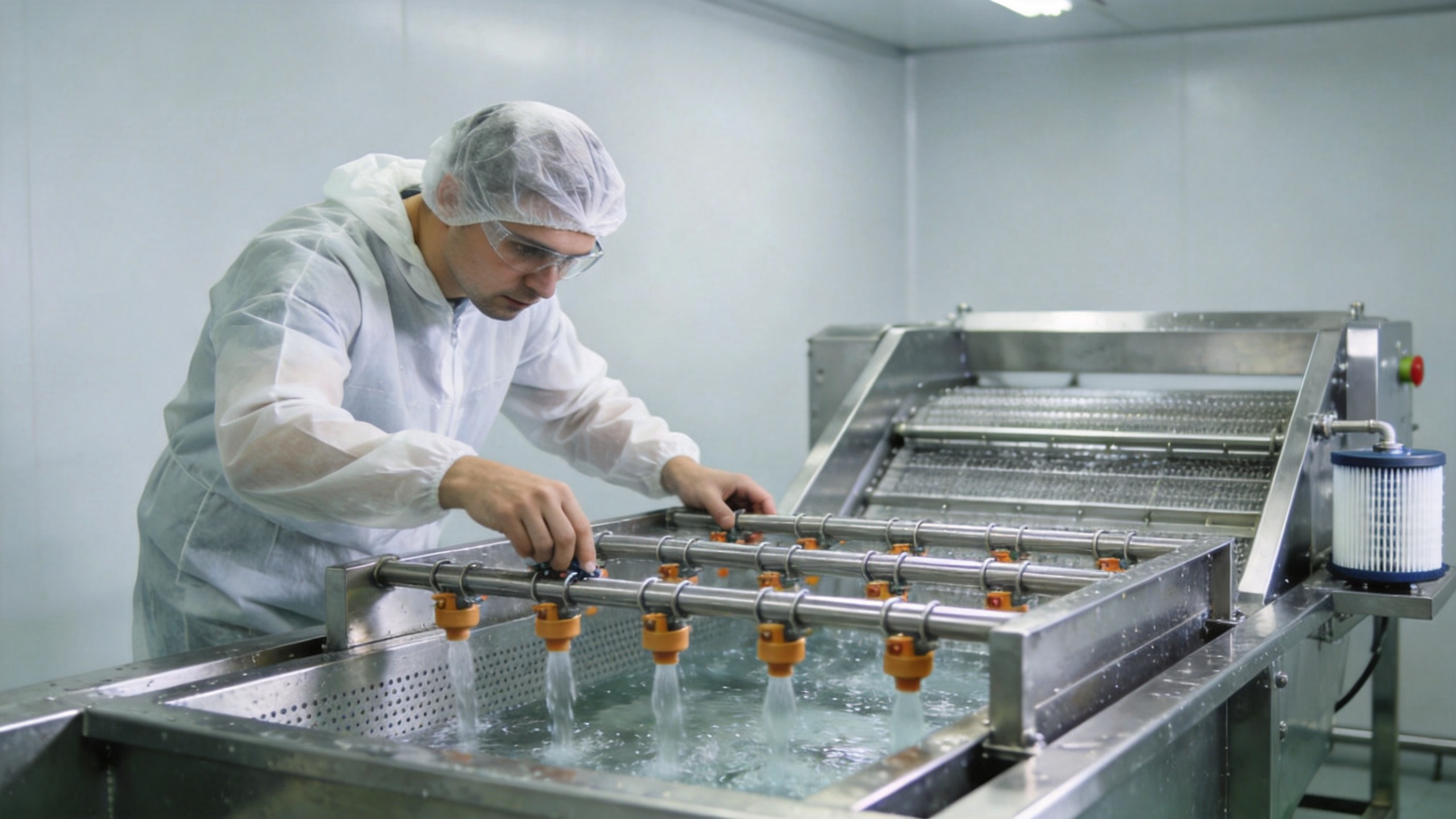
The water circuit deserves special attention because a vegetable cleaner machine depends on consistent circulation and drainage. With the machine safely isolated, inspect the tank, pump intake, filters, drain valve, hoses, clamps, and visible seals. Remove debris from filters according to the manual; a partially blocked screen can reduce flow and increase pump load.
Look for drips around hose connections, worn gaskets, unusual discoloration, cracked tubing, or loose clamps. During an authorized test run, watch for unstable water level, poor circulation, air entering the pump, or drainage that is slower than normal. Do not compensate for a restriction by simply running longer. Find the cause, correct it, and document the action.
Check Mechanical Components and Safety Devices
Mechanical checks should focus on condition rather than guesswork. Examine conveyor belts or rollers for tracking, damaged links, trapped debris, and unusual wear. Confirm that guards, fasteners, handles, and adjustable guides are secure. If your model uses a vibration, bubble, or vortex washing function, listen for a new rattle, grinding sound, or vibration pattern during the test cycle.
Also test the safety features permitted by your site procedure: emergency stops, guard interlocks, start/stop controls, indicator lights, and control-panel messages. A safety device that does not respond correctly is a stop-work issue, not a note for the next shift. Keep lubrication limited to points and lubricants specified by the manufacturer, and prevent lubricant from entering food-contact areas.
Use a Pre-Operation Readiness Check
Before bringing produce to the line, carry out a final readiness check. Verify that all removed parts are correctly reinstalled, drains are in the intended position, and no tools or cleaning materials remain inside the vegetable cleaner machine. Confirm water supply and discharge conditions, then run an empty test cycle where your procedure allows it.
| Check point | What to verify | Action if not acceptable |
|---|---|---|
| Product path | Clean, assembled, and free of foreign material | Clean again and reinspect before release |
| Water flow | Stable circulation, no visible leaks or blocked outlets | Stop and inspect filters, valves, hoses, and pump inlet |
| Controls and guards | Guards secured; controls and emergency stop respond correctly | Keep equipment out of service and notify maintenance |
| Drainage | Wastewater exits without backing up | Clear approved drain points and investigate restrictions |
Plan Weekly and Monthly Maintenance, Not Just Shift Cleaning
Daily tasks keep the vegetable cleaner machine hygienic and operable. Weekly and monthly work helps prevent gradual wear from becoming downtime. Review belts, bearings, pump condition, electrical enclosures, fasteners, and seals at intervals set by the manufacturer and your maintenance plan. Trend recurring observations, such as a filter that clogs early or a seal that repeatedly weeps, because these patterns can point to upstream handling or water-management issues.
For operations evaluating equipment options, the Vegetable and Fruit High Efficiency Commercial Stainless Steel Disinfection Vortex Fruit Washing Machine can be reviewed alongside your required cleaning access, drainage layout, and shift-maintenance procedures. Use the confirmed product page for specifications and application discussion rather than assuming one maintenance routine fits every configuration.
Shift-by-Shift Vegetable Cleaner Machine Checkpoints
Use the following short prompts at the line. They make the vegetable cleaner machine check specific enough to hand over between shifts without turning the routine into a lengthy maintenance shutdown.
- Confirm the vegetable cleaner machine is isolated before any internal cleaning begins.
- Check that the vegetable cleaner machine tank is empty before removing screens.
- Inspect each vegetable cleaner machine screen for trapped debris and damage.
- Verify vegetable cleaner machine spray openings are clear after cleaning.
- Inspect vegetable cleaner machine drains before filling the wash tank.
- Check vegetable cleaner machine hoses and clamps for leaks or movement.
- Look at vegetable cleaner machine seals for wear, cracks, or residue buildup.
- Confirm vegetable cleaner machine guards are reinstalled and secure.
- Test the vegetable cleaner machine emergency stop under the approved procedure.
- Listen for unusual vegetable cleaner machine pump noise during the empty run.
- Watch vegetable cleaner machine water circulation for unstable flow or air intake.
- Verify the vegetable cleaner machine discharge area is clean and unobstructed.
- Check vegetable cleaner machine conveyor tracking where the configuration includes one.
- Keep vegetable cleaner machine lubricants away from food-contact zones.
- Confirm vegetable cleaner machine cleaning chemicals have been rinsed as required.
- Release the vegetable cleaner machine only after the final visual inspection.
- Record vegetable cleaner machine defects before the next production batch starts.
- Escalate any vegetable cleaner machine safety failure immediately.
- Review recurring vegetable cleaner machine issues during the weekly maintenance meeting.
- Use the vegetable cleaner machine manual to set model-specific intervals and limits.
Make the Checklist Part of Production Discipline
A reliable maintenance routine turns inspection into a production habit. Assign clear ownership, keep records close to the line, and define who can release the vegetable cleaner machine after sanitation or repair. When operators can identify debris buildup, poor flow, unusual noise, or a failing safety device early, the team can act before wash quality or schedule reliability is affected.
Use this checklist as a working baseline, then adapt the frequency and acceptance limits to your machine manual, product type, water system, and sanitation validation plan. Consistent daily care is one of the simplest ways to protect both equipment availability and the hygiene conditions needed for food processing.