EN


Peanut Butter Making Machine: How to Match Grinding Capacity to Your Factory
Choosing a peanut butter making machine is not simply a matter of selecting the largest hourly rating. For a factory buyer, the useful question is: how much finished peanut butter must leave the line in each production shift, and which upstream and downstream steps can support that pace? A well-matched peanut butter grinding machine keeps roasting, cooling, feeding, grinding, mixing, and packing in balance. An oversized grinder can still spend much of the day waiting for peanuts or packaging; an undersized one can turn into the bottleneck that limits every later step.
This practical selection method is designed for commercial peanut butter production equipment projects. It starts with required saleable output, then works backward through operating time, product losses, viscosity targets, and packaging speed. The result is a capacity brief a supplier can review with you before the line is specified.
Start with finished output, not the grinder nameplate
Begin with the quantity of packed product your factory needs to ship or hold each day. Convert it into an hourly requirement using realistic net production time rather than the full length of a shift. For example, a target of 1,200 kg per day across one eight-hour shift is not automatically 150 kg/h. Cleaning, material changes, inspection, warm-up, and short stops reduce the hours in which the peanut butter making machine is actually producing.
A simple planning formula is:
Required grinding rate = daily finished-output target ÷ effective production hours ÷ expected yield factor
If the line has 6.5 effective hours and an expected 95% yield after routine handling and changeovers, a 1,200 kg daily target needs about 194 kg/h of usable capacity. A buyer should then discuss an appropriate operating margin with the supplier instead of assuming that a 200 kg/h rating may provide enough headroom.
- Daily demand: use the planned packed output, not raw peanut intake.
- Effective hours: subtract realistic downtime for cleaning, feeding, quality checks, and packaging adjustments.
- Yield factor: include normal process losses and product remaining in transfer points.
- Growth allowance: consider foreseeable demand growth, but avoid paying for capacity that the rest of the line cannot use.
Check the whole process around the peanut butter grinding machine
Grinding is central, but it is only one link in a commercial line. A common process sequence includes raw-peanut preparation, roasting, cooling, peeling or sorting, grinding, mixing or conditioning, and filling or packaging. The line capacity is governed by its slowest dependable step. If roasted peanuts are not cooled and delivered consistently, a high-capacity peanut butter making machine cannot maintain its rated output. If the filler is slower than the grinder, work-in-process volume and holding conditions become the next concern.
Map the planned rate for each station in kg/h and compare it against the calculated requirement. As a practical purchasing rule, supporting equipment should be able to supply or receive the grinder’s normal operating rate with a sensible buffer. Ask how material is transferred between each station, how long product can wait, and who controls the line when one section slows.
| Line section | Capacity question to ask | Why it matters |
|---|---|---|
| Roasting and cooling | Can it supply cooled, stable peanuts at the planned hourly rate? | Feed interruptions reduce grinder utilization. |
| Feeding and pre-treatment | Is the feed uniform and matched to the grinder inlet? | Inconsistent feed can affect throughput and texture control. |
| Peanut butter grinding machine | What rate is expected for your recipe and target fineness? | Nameplate output may vary with formulation and operating conditions. |
| Mixing, holding, and degassing | Can downstream vessels handle the same batch or continuous flow? | Prevents backup after grinding. |
| Filling and packing | How many containers per minute can be filled at each pack size? | Confirms that finished product can leave the process. |
Specify product requirements that change real throughput
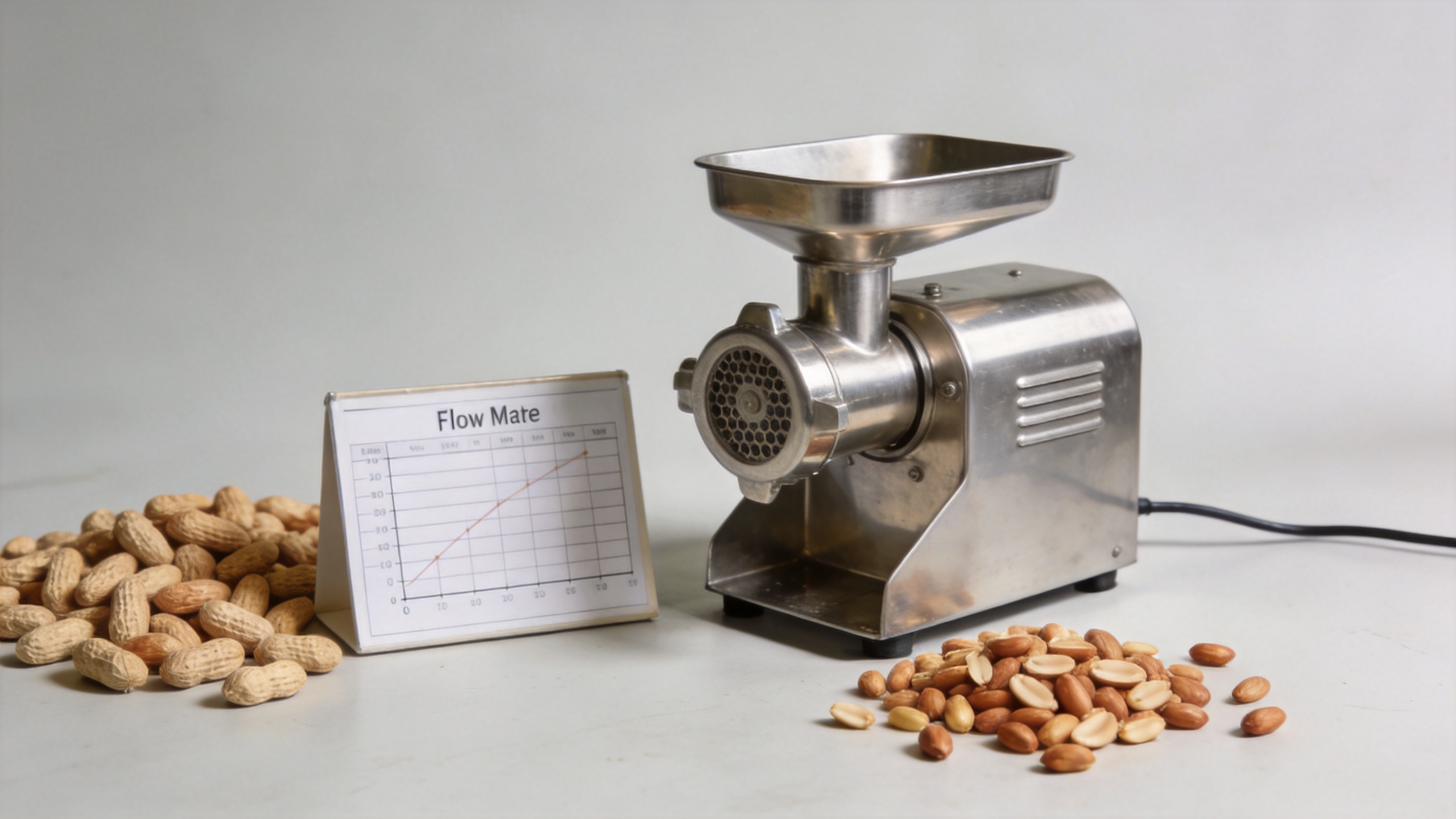
Two factories can buy the same peanut butter making machine and obtain different real outputs. Recipe and product specification matter. A smooth spread, a crunchy style with added particles, a high-viscosity formulation, or a product with different oil, sugar, salt, or stabilizer additions may require different processing conditions. Required particle size, number of grinding passes, feed temperature, and cleaning frequency can also influence achievable rate.
Give suppliers a short product brief: peanut type and preparation method, desired texture, target fineness, ingredients added after grinding, planned pack sizes, and whether you expect one recipe or frequent changes. This information makes a peanut butter grinding machine quotation more useful because the supplier can explain what its stated capacity represents.
Use capacity bands as orientation, then validate the duty point
Commercial market listings span a broad range: compact machines may be described around 60–80 kg/h, while production systems are offered from a few hundred kilograms per hour into multi-tonne ranges. These figures are orientation points, not universal guarantees. The decision should be based on your calculated duty point, recipe, expected operating time, and the capacity of adjacent equipment.
For factories planning close to 200 kg/h, the confirmed product information for an automatic 200 kg/h peanut butter production machine for nut factories can be a relevant discussion starting point. Confirm the final output, vacuum-packing configuration, utilities, and recipe suitability directly with the supplier before purchase; these details should be matched to the complete line rather than treated as stand-alone assumptions.
Build a supplier comparison sheet before you buy
At the consideration stage, compare quotations on the same production basis. Request the stated capacity with the product type and conditions behind it. Ask whether the rating is continuous or batch-based, what material preparation is assumed, what utilities are required, and what normal cleaning or changeover time should be included in a shift plan.
- State the daily target, planned shifts, and effective operating hours.
- Provide the product brief and target texture for the peanut butter making machine.
- List the capacity of roasting, cooling, feeding, mixing, filling, and packaging equipment.
- Ask for the expected operating range, not only the maximum rating.
- Review expansion options only after confirming the first-stage line is balanced.
Make the final choice around balanced production
The right peanut butter making machine is the one that supports your required packed output without forcing the rest of the factory to chase an unrealistic rate. Calculate the duty point from finished demand, protect it with realistic operating-time assumptions, and verify every process step around the grinder. With that approach, the peanut butter grinding machine becomes part of a controllable production system rather than an isolated purchase.
For a more accurate quotation, share your output target, recipe, available shift time, and planned packaging format with the equipment supplier. A capacity discussion based on these facts is far more reliable than comparing headline kg/h figures alone.