EN


How Cashew Nut Peeling Works in an Automated Processing Line
In a modern cashew plant, cashew nut peeling is not an isolated finishing step. It is the controlled removal of the thin brown testa after shelling and kernel conditioning, and it has to stay in rhythm with drying, separation, grading, and packing. A line can remove skins quickly yet still lose value if it creates too many broken kernels, leaves too much testa behind, or feeds the next station unevenly.
For processors moving from manual handling to an integrated line, the useful question is not simply “which peeler is fastest?” It is how the entire process prepares kernels for peeling and how the peeler passes clean, intact kernels to sorting and packing. As an equipment-manufacturing perspective, that connection is where stable output is usually won or lost.
Where cashew nut peeling fits in the automated process
Automated cashew processing begins with raw-nut preparation and shell removal. Once kernels have been released from their shells, they still carry the testa. The kernels are then conditioned—commonly through a controlled drying stage—before they reach the peeling section. Conditioning matters because the skin must become loose or brittle enough to separate without excessive force on the edible kernel.
The practical sequence is usually: shelling and kernel separation, drying or conditioning, cooling where required, cashew nut peeling, skin-and-kernel separation, grading, inspection, and packing. Exact equipment layouts vary by capacity, raw-nut origin, kernel grade targets, and local utility conditions. Still, each handoff has the same purpose: deliver kernels in a repeatable condition to the next machine.
Why conditioning before peeling matters
Peeling performance depends on more than the peeler itself. Kernel moisture, temperature history, size distribution, and the condition of the shelling output all affect how easily the testa releases. Industry process guidance commonly describes drying as a way to reduce moisture and loosen the testa before skin removal. If kernels enter too soft, the skin may cling. If they are over-conditioned or handled too aggressively, breakage can rise.
This is why a line should not be tuned around a single headline capacity. One batch of nuts can behave differently from another because kernel size and raw-material consistency change. A stable recipe for conveying speed, drying conditions, and peeling intensity is usually more valuable than maximum short-term throughput. In other words, the actual result depends on the kernels arriving at the peeler in the condition the process was designed to handle.
How mechanical cashew peeling removes the testa
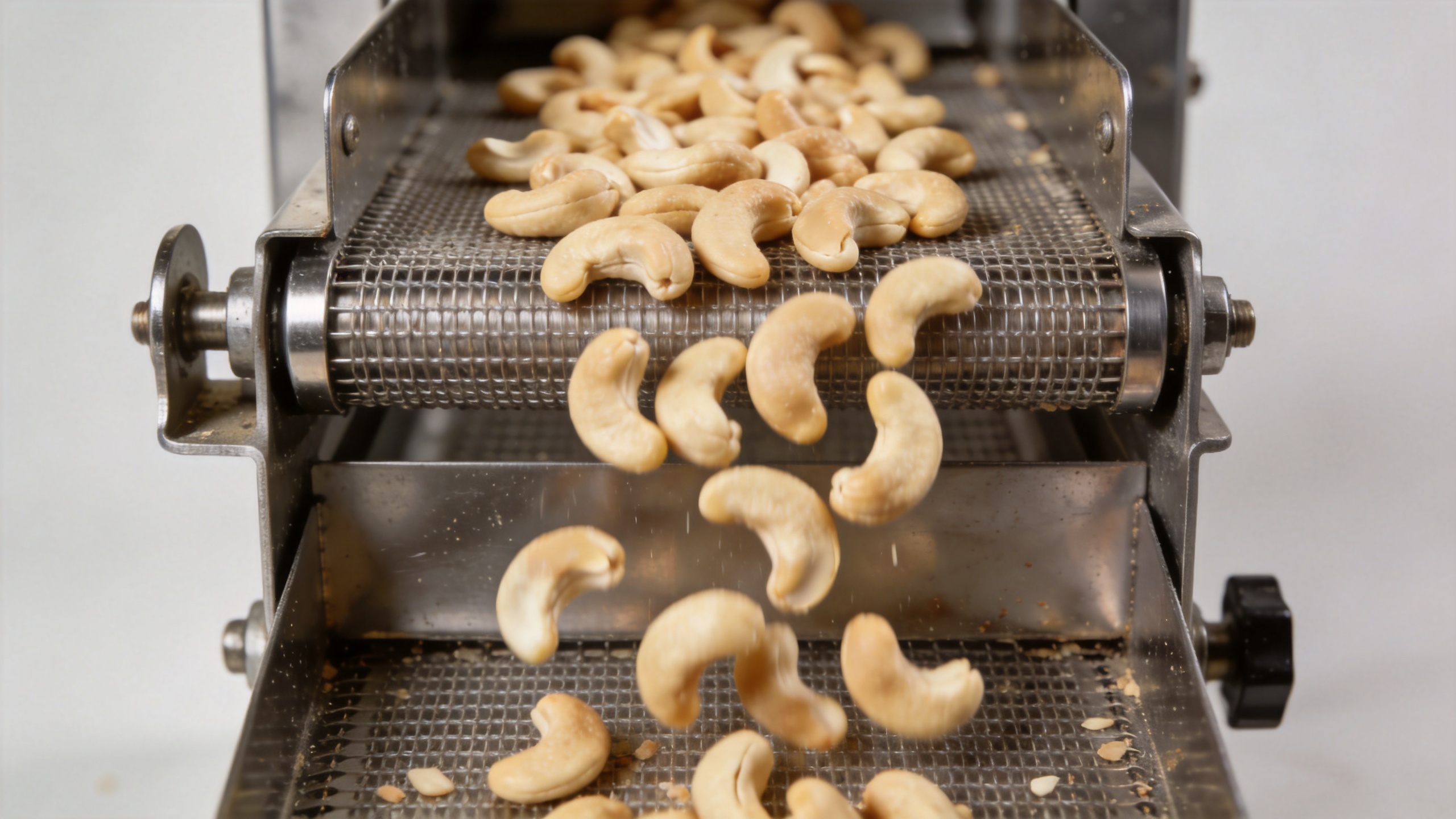
In automated cashew nut peeling, machines use controlled mechanical action to detach the loosened testa. Depending on the line design, that action can combine gentle friction, rollers or contact surfaces, and airflow. Airflow is useful not only during separation but also after peeling, when lightweight skin fragments need to be drawn away from the kernels.
The aim is not to grind the skin off. It is to apply enough action to release the testa while protecting whole kernels. This balance is especially important when a processor sells higher-value whole grades. A line that removes skin cleanly but turns whole kernels into pieces may reduce the value of the output. For that reason, operators normally watch more than “skin removal rate”: they also inspect residual testa, whole-kernel yield, broken-kernel level, and the cleanliness of the material stream.
Separation is part of the peeling job
After the peeling chamber, kernels and skin fragments must be separated reliably. Screens, air separation, conveyors, and inspection points help prevent loose testa from following good kernels into grading. Poor separation can make a finished batch look inconsistent and creates extra work at manual inspection. It can also make it harder to understand whether a quality issue began at drying, peeling, or downstream handling.
Quality factors that affect the result
Four operating questions deserve attention in any cashew peeling line:
- Kernel condition: Are size, moisture condition, and shelling quality reasonably consistent before the peeler?
- Peeling intensity: Is the setting strong enough to remove testa without creating unnecessary breakage?
- Material flow: Are conveyors and buffers feeding the machine evenly rather than creating surges or empty running?
- Inspection feedback: Are residual skin and breakage checked often enough to adjust upstream conditions?
Many factories discover that line compatibility matters as much as the individual machine. A peeler may perform well in a demonstration, yet its result changes when the incoming conveyor, dryer discharge, and grading section run at different rhythms. Planning the interfaces early makes it easier to protect kernel integrity and maintain a smoother production flow.
Connecting peeling with grading and packing
Once cashew nut peeling is complete, the product is normally graded by whole and broken forms, size, color, and visible defects according to the buyer’s specification. This is where the value of gentle peeling becomes visible. Better skin removal and lower breakage give the grading section a more consistent input, while clean separation reduces the amount of rework before packing.
Packing is the final handoff, not an afterthought. The packing section should receive kernels that have passed the required inspection and are conveyed without unnecessary drops or crushing points. When shelling, peeling, grading, and packing are designed as one system, operators can trace issues back through the line rather than treating each station as a separate problem.
What to evaluate when planning an automated line
Before selecting equipment, define the desired finished grades, expected raw-nut variation, target capacity, available utilities, and cleaning/maintenance routine. Ask how the supplier will connect shelling, conditioning, cashew nut peeling, and packing—not merely what each machine can do alone. It is also wise to confirm how settings can be adjusted for different lots and how operators will check residual skin and breakage during production.
For plants seeking an integrated starting point, an industrial cashew nut shelling, peeling, and packing processing machine line can help frame the required station-to-station workflow. The final configuration should still be matched to the factory’s capacity, raw material, and grade requirements.
Conclusion
Effective cashew nut peeling comes from process control, not force alone. Proper kernel conditioning makes the testa easier to remove; gentle mechanical action and air separation protect the kernel; and coordinated grading and packing preserve the value created upstream. When these stages work as one automated system, processors are better positioned to produce cleaner, more consistent cashew kernels with less avoidable rework.